Nipple–Areola Complex
The nipple–areola complex is a specialized anatomical structure with both functional and aesthetic significance.
Understanding its composition is essential for achieving accurate and natural results in paramedical dermopigmentation.
Nipple
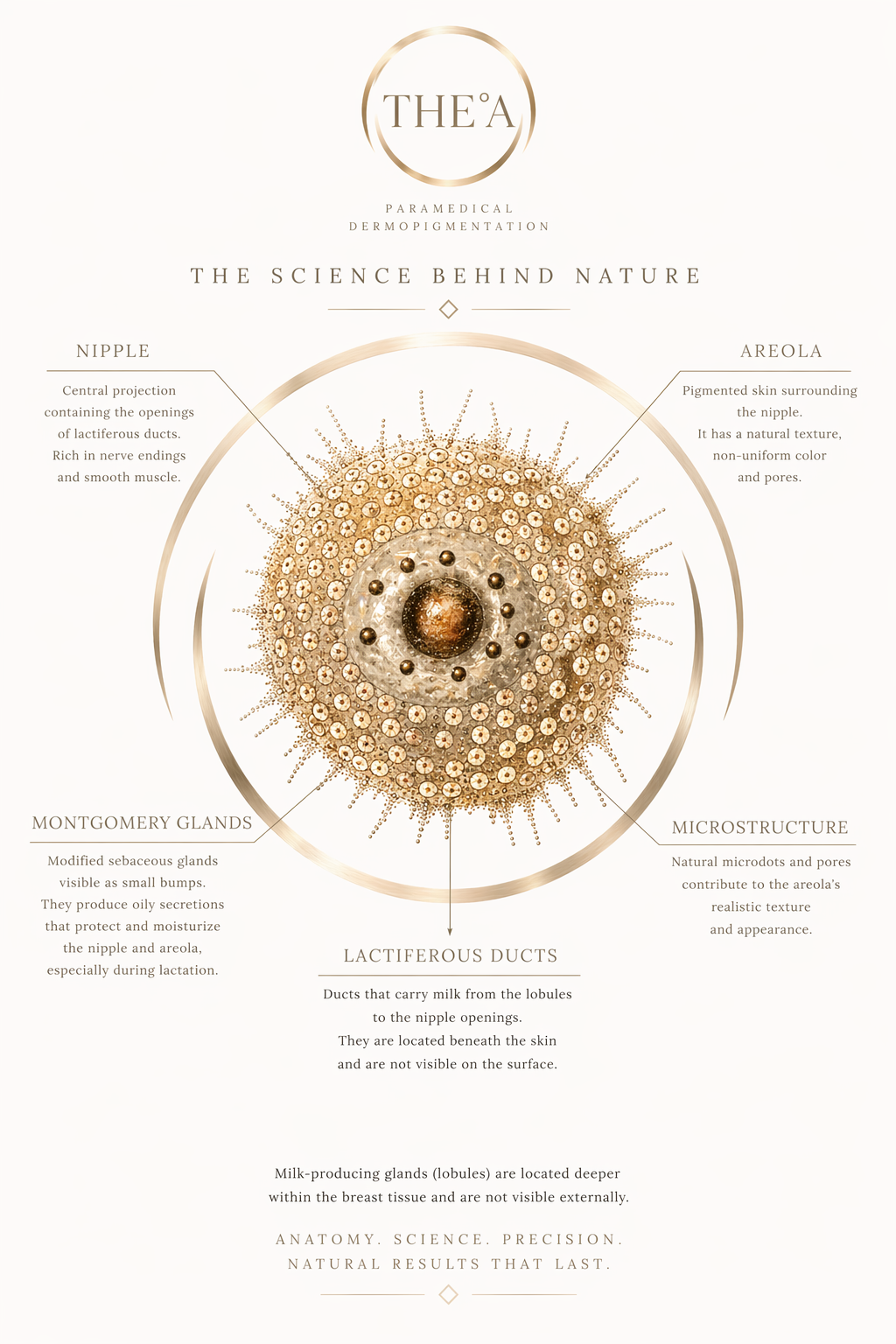
The nipple is the central projection and serves as the outlet for the lactiferous ducts, which transport milk from the underlying glandular tissue.
It is characterized by a high concentration of nerve endings, the presence of smooth muscle fibers, and a distinct functional sensitivity.
Areola
The areola is the pigmented area surrounding the nipple and is not uniform in color or texture.
It presents natural variations in pigmentation, a slightly uneven surface, and subtle microstructures that contribute to its realistic appearance.
Montgomery Glands
The small visible elevations within the areola correspond to Montgomery glands.
These are modified sebaceous glands that produce lipid-rich secretions, helping to protect and moisturize the nipple and surrounding skin.
Their presence is a natural anatomical feature and contributes to the overall texture of the areola.
Underlying Structure
The milk-producing glands (lobules) and ductal system are located deeper within the breast tissue and are not visible on the surface.
What is seen externally is the visual expression of this internal structure.
Relevance in Paramedical Dermopigmentation
Paramedical dermopigmentation in this area is not a decorative procedure.
It requires anatomical understanding, precision in pigment placement, and careful adaptation to individual skin characteristics.
The goal is to recreate a natural appearance that integrates seamlessly with the surrounding tissue.
Conclusion
The nipple–areola complex is defined by structure, variation, and subtle detail.
Effective restoration depends on respecting these elements.
The objective is not to replicate an image,
but to restore visual harmony.
THE•A™
Paramedical Dermopigmentation
The goal is not to replicate,
but to restore.
.
Follow us for more.